Delphine is rescued from the privy
The Master Butchers Singing ClubDelphine is rescued from the privy through the quick, practical intervention of Step-and-a-Half, who finds her abandoned as a newborn in the Shimeks’ outdoor toilet and carries her to safety. The episode turns on a narrow margin between death and survival: Step-and-a-Half’s decision to investigate a cry, and then to take the infant with her, gives Delphine a life and begins the unconventional caregiving bond that shapes her childhood.
Discovery in the Night
The rescue is recounted as a memory from more than forty years earlier. On a bitter October night, after Argus had grown quiet, Step-and-a-Half walked past the Shimeks’ property. She usually treated it as a place to scavenge discarded bones, hairballs, and stained newspapers, and would ordinarily have kept moving. Instead, a groan from the closed outhouse stopped her. She waited as it sounded several more times, each cry more urgent, until she became certain someone inside needed help.
Before Step-and-a-Half could open the door, Mrs. Shimek emerged and staggered toward her darkened house. The apparent end of the disturbance did not settle the matter: one more cry came from inside the privy. Step-and-a-Half entered and found the floor and seat soiled with blood. The outhouse had not been moved to a newly dug winter pit, as was customary in autumn. That circumstance left the infant within reach. Step-and-a-Half strained down through the opening and caught the baby by the heel.
Rescue and First Care
Step-and-a-Half freed the newborn and severed the umbilical cord with her teeth. She cleared the baby’s mouth, breathed air toward her face, and tucked her against her own body beneath the layers of clothing she wore. The infant had drawn her afterbirth up with her along the cord; she had also cried only once before her mouth sank below the level of the waste. The scene makes survival depend on small, immediate acts rather than on any assurance that the child would be safe.
Step-and-a-Half carried the baby to the temporary shelter she used as a den: a barn and then the home of Roy Watzka, a bachelor farmer on the edge of Argus. She had stayed there for a few weeks. Roy had fallen in love with her and proposed marriage, imagining a settled life with a milk cow, a ring, a wagon, a horse, chickens, and even a hand organ. His condition was that she give up wandering. Step-and-a-Half knew she would bring the baby to him, but the rescue did not mean she accepted his plan to settle down.
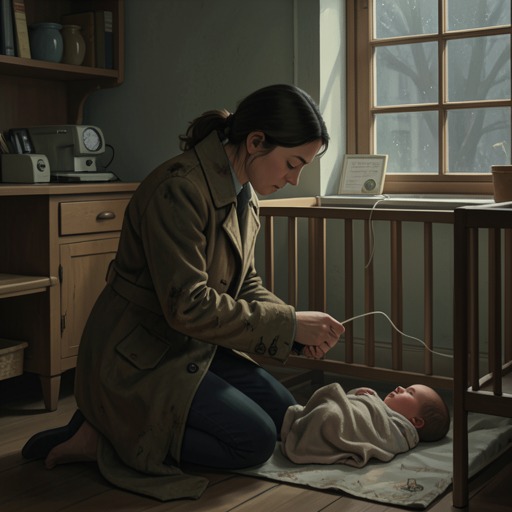
By the time they reached Roy’s sturdy house of boards and tarpaper, the baby was alive and desperately hungry. Step-and-a-Half ordered Roy to stoke the fire and milk his goat, whose milk she thought suitable for the child. He was startled to see that she had brought a baby, but he quickly fetched milk. While he was gone, she boiled water and prepared to clean and feed the infant. She twisted a rag into a teat, dipped it repeatedly in the milk, washed the baby, clipped a clothespin onto the short remnant of the cord, and wrapped her in a ripped flannel pillowcase.
Roy asked to hold the baby. Though he first struggled to find a comfortable way to support her, he settled with her in a rocking chair whose joints needed repair. The rescue had become shared care: Step-and-a-Half handled the urgent work of keeping the newborn warm and fed, while Roy took the child into his arms. The episode does not describe a formal adoption; it shows the practical beginning of Delphine’s life in Roy’s care.
Memory and Lasting Significance
The adult Step-and-a-Half later regards the discovery as the find that defined her life, shaped her wanderings, and gave her actions an enduring direction. The memory remained vivid more than four decades afterward, along with the consequences she had watched unfold. As she saw Delphine grow up, she repeatedly thought of how narrowly the girl had escaped a terrible fate: the distance between danger and survival was, in her recollection, as small as the infant’s brief descent in the pit.
The event’s importance is both immediate and lasting. Step-and-a-Half’s choice changes the newborn’s circumstances from abandonment to care, while Roy’s participation turns a solitary rescue into the start of a household bond. Their relationship with Delphine begins outside the usual expectations of biological parenthood and settled domestic life: the wandering woman who saved her and the farmer who agreed to help raise her become the people who receive the child. The later account presents Delphine’s survival not as an assured destiny but as the consequence of attention, persistence, and a decision made in the dark.